
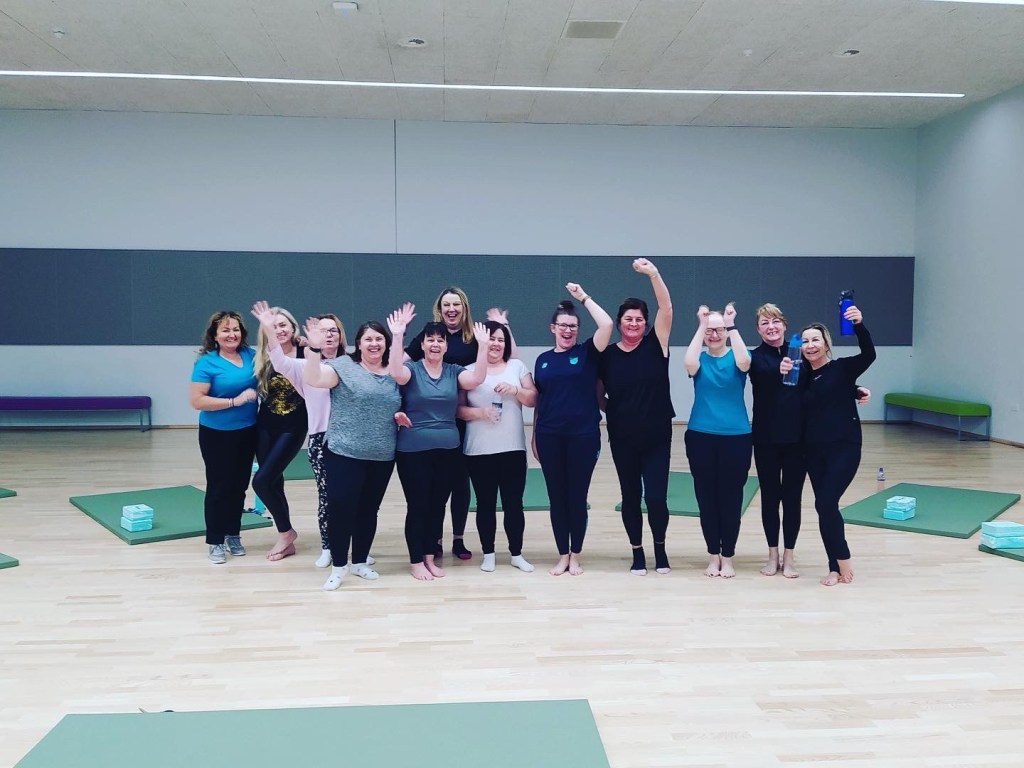
I used to teach menopause yoga at Liverpool John Moores University, and I think about the women in those classes quite often, because they were some of the most impressive women I have ever met. They were funny, capable, no-nonsense people who had spent decades working and raising families, yet by the time they got a sniff of early retirement, many of them seemed completely ready to bugger off.
I understood why.


Menopause, to me, is almost literally men-o-pause. I do not even mean that as a pun. I mean there is a point in a woman’s life when, after decades of being expected to accommodate men, attract men, please men, reproduce with men, raise children with men, work alongside men and participate in a society largely organised around male lives and male working patterns, the menopause arrives and, finally, there is some relief.
Women spend a huge part of adult life dealing with periods, contraception, pregnancy, the avoidance of pregnancy, fertility, childbirth, childcare, relationships, domestic work and ageing parents, while also being expected to compete in careers and remain pleasant through all of it.
You would think this is the moment society looked at a woman and thought: perhaps we should put her in charge of something?
Instead we give her the grandchildren.

I am not suggesting grandmothers should never look after their grandchildren. Plenty of women love doing it, and that is wonderful. What I object to is the assumption that Grandma is there, Tuesday afternoons, or whenever the working day, school day, school holidays, nursery fees and reality fail to line up.
Because they do not line up, do they? We have constructed an economic system in which parents are expected to work full-time, while schools finish in the middle of the afternoon and close for enormous stretches of the year. Childcare is expensive, work is inflexible, yet the missing hours quite often come from Grandma for free.



And because women keep quietly solving this problem inside families, the wider system never has to confront what childcare and childrearing actually cost.
Grandma collects the children from school, so nobody has to redesign the working day. Grandma has them during the holidays, so nobody has to ask why annual leave and school holidays exist in completely different universes. Grandma steps in when nursery becomes unaffordable, so the economy never receives the bill for the labour it is relying on.

And this is why Grandpa annoys me in this arrangement. Men have had a very long time participating disproportionately in the institutions that decided what counted as valuable in the first place. They made the laws, ran governments, controlled businesses, designed accounting systems and constructed the financial economy in which labour becomes visible once somebody pays a wage for it, but can almost disappear completely when a woman performs it inside a home.
That disappearance is particularly absurd when you look backwards. Women did not merely sit around while men built civilisation. Women worked, produced food, made goods, raised children and produced the next generation of workers upon whom every system of production depended.
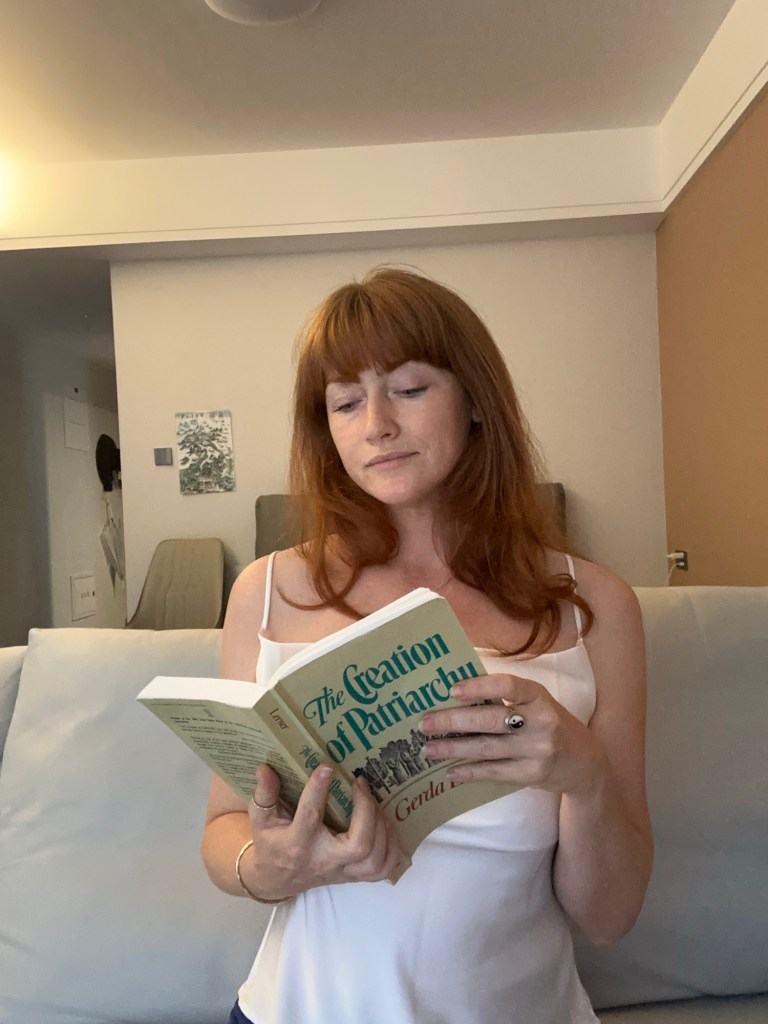
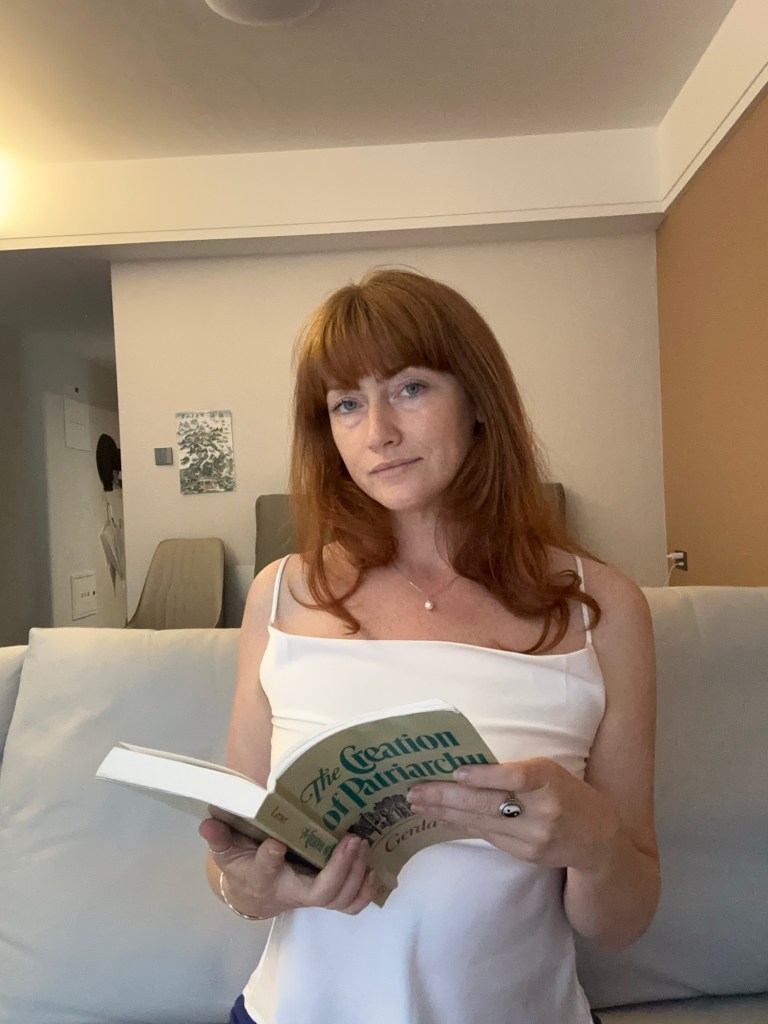
Gerda Lerner’s argument about the development of patriarchy is interesting to me precisely because she places control of female reproduction extremely early in the story. As societies became more dependent upon organised labour, the woman who could work was valuable, but the woman who could also produce more workers was extraordinarily valuable.

From Mesopotamian clay tablets to Excel, we have always been brilliant at counting production and strangely forgetful about counting who produced the producers.
Women may well have been instrumental in the appropriation of female reproductive labour. Of course they were. Women have always participated in the societies they lived in, including the systems that later disadvantaged them. That is the really tragic bit. You can help build the machine without realising that, several generations later, it is going to run over you.

And before somebody says, ‘Well then women can go and fight the wars’, fine. I’ll fight in a war I instigate, thanks. Fighting is hardly beyond women anyway. Have you ever watched a Scouse ma clock that someone has threatened her child? Terrifying. There is your infantry.

So yes, Grandpa, I am looking at you. You can fuck off into retirement slightly earlier.
You have had forty years shaping the paid economy that knows precisely what an hour of your labour costs. Grandma has spent much of the same forty years doing paid work while also providing quantities of labour that nobody bothered to invoice.
In fact, I propose that men should be encouraged to retire first and take over the grandchildren, while women of the same age are fast-tracked into leadership because after several thousand years of allocating prestige to one sort of labour and extracting another sort for free, I think a little administrative correction is overdue.

And there is another uncomfortable reason we are so much more relaxed about leaving children with Grandma than Grandpa, and it is not simply that we have ‘coded care as women’s work’. Child sexual abuse is overwhelmingly perpetrated by men, and very often by somebody the child already knows and trusts, including family members.
When men take on work historically assigned to women, we often congratulate them for it. A father changes a nappy and he is wonderful; a woman prioritises her career and somebody asks who’s got the kids? Women have been expected to master the male world while continuing to carry the female one, while men are still applauded for occasionally entering ours.

UK benefits are one of the few places where the state directly acknowledges that raising a child costs money. My sister is a good example. She had a child with a useless man, chose to raise her child alone and quite rightly received support from the state. Later she married a decent man whose income was high enough to trigger the High Income Child Benefit Charge. She can still receive the Child Benefit directly, while he pays the corresponding charge through tax.
Government gives Mum the money, then sends her husband the bill. Flipping genius.
I am not sure what Eleanor Rathbone, the Scouser who fought for family allowances to be paid directly to mothers, would have made of that particular arrangement, but I suspect she might have enjoyed the principle.
And all of this is happening while governments around the world worry about falling birth rates and the shrinking population of future workers. Fine. Here I am. I am 39, so I have even applied a discount. If my reproductive capacity has become an economic concern, you are welcome to buy it.

What I am no longer willing to accept is reproduction being described as economically essential right up until the moment somebody has to put a price on the labour involved.
This is why I keep coming back to those women in my menopause yoga classes. They had exactly the qualities we constantly claim to want in leaders and very little remaining tolerance for bullshit. Many of them had reached the point in life where they were finally less concerned with being liked and more confident in what they thought. They should have been entering their most powerful years. Instead, many of them were just knackered.
So this is my proposal: Grandmas, stop looking after the grandchildren. Stop being the automatic answer every time society creates a care problem and assumes a woman somewhere will absorb it for free. Let the economic system feel the gap. Let it discover what childcare actually costs.
Let Grandpa do it. (but keep an eye on him) subsidise discounts for grandads at soft play, go ed grandad, grandma has somewhere else to be.
References
- Gerda Lerner, The Creation of Patriarchy (1986). The book behind the discussion of women’s reproductive capacity, labour and the historical development of patriarchy.
- UK Parliament, ‘Family Allowances Act 1945’. Useful background on Liverpool-born Eleanor Rathbone’s long campaign for family allowances and her insistence that payments should go directly to mothers as a matter of women’s economic independence. Parliament News
- GOV.UK, ‘High Income Child Benefit Charge’. Explains how Child Benefit can continue to be paid to the claimant while the higher-earning partner repays some or all of its value through tax. The charge currently begins above £60,000 adjusted net income and reaches the full value of Child Benefit above £80,000. GOV.UK
- Office for National Statistics, ‘Abuse during childhood in England and Wales: March 2024’. Among adults who reported experiencing childhood sexual abuse, 91.3% said the perpetrators were male only; the majority knew the perpetrator. Office for National Statistics
- Centre of expertise on child sexual abuse, ‘What you need to know about child sexual abuse’. Reports that almost 99% of people prosecuted for child sexual abuse offences in 2024 were men, while stressing that women can also perpetrate abuse. CSA Centre
- ABC News, ‘The lost time of modern parenthood’ (19 September 2026). Calculates that two full-time working parents with primary-school children can face at least 814 hours a year when work and care requirements overlap, and discusses the resulting reliance on mothers and grandparents.


I showed this post to the patriarchy and we all agreed that you look like a proper saucy little minx in those photos.
LikeLiked by 1 person
Carlos, you cannot appoint yourself spokesman. Plus you’re trying to save the birds! Know your department. Although vampire finches… now they are saucy little minxes.
LikeLiked by 1 person
I’ll have you know I’m an extremely active and influencial member of my local branch of the patriarchy. I take the minutes at our monthly meetings, bake delicious cakes for our coffee mornings, and try to keep women in their place at every opportunity.
As for birds, I think they’re currently saving me more than I’m saving them.
LikeLike
You take minutes and bake cake? Carlos, get the fishnets on and report to the women.
LikeLiked by 2 people
Paris Paloma’s Labour was drumming through my ears while reading this.
Such a nice take on the modern times and patriarchy!
Thanks for sharing
LikeLiked by 1 person